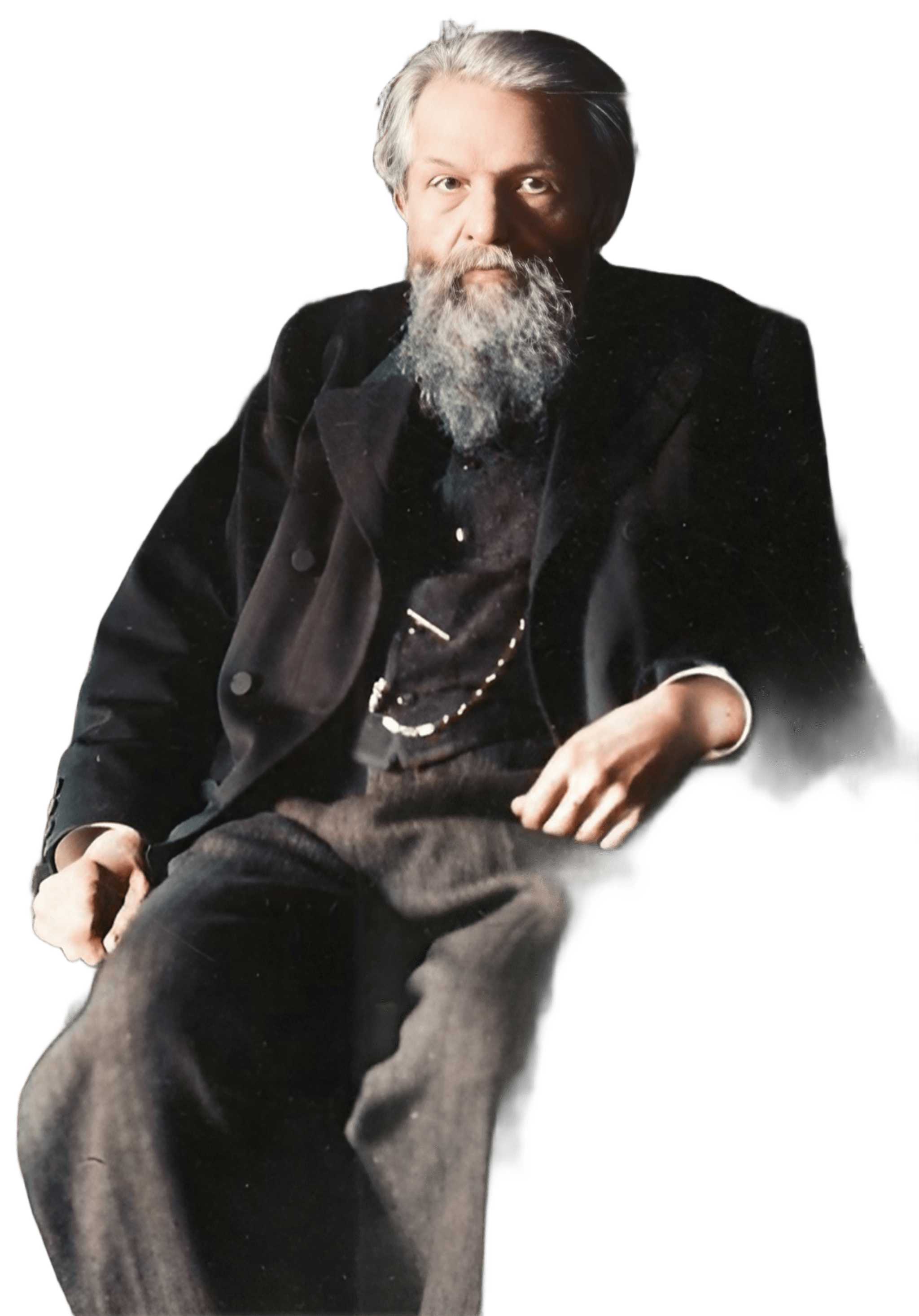
Regarding this work, from what I have read, and from what Hayek and the critics have said, there are few works like this one, a work that sought to understand truth in its ramifications and in itself.
As Hayek himself says in his long monologue in the book.
What I read about his students, and especially about what they say of him, cannot be described otherwise than as that of an erudite-classical man, devoted to the fulfillment of his tasks in a technical and reflective manner. It cannot be said that Menger ever aspired to power as it is commonly known, but rather to the pursuit of knowledge and truth, especially when he rejected the high courts and even titles of nobility. To my own person the erudite life, as described, no longer seems distant, but it may be said that, had he been born some centuries ago, we would find him nowhere but in monasteries devoted to the study and profound understanding of truth.
After his death (he died at nearly 81 years of age), he left all his books, more than twenty thousand volumes in all, to the prestigious Hitotsubashi University in Tokyo []; nevertheless, he left an intellectual fortune of inestimable value and some of his most celebrated students, who updated and covered possible gaps concerning his theory and his manuscripts [].
Menger calls “useful things” all things whose purpose is to remedy a causal need. And, for a thing, as a useful thing, to become a good, it must, according to Menger, meet four requirements: first, the existence of a need upon which this useful thing can exist; second, that the thing possess qualities that can be placed at the disposal of needs; third, knowledge of the need and of the useful thing; fourth, that man be able to dispose of this thing so as to satisfy a need. As to the last, I am not entirely sure, but I take the first ones as certain.
There are goods that a man may not dispose of, that is, that are not a good for him, yet are still characterized as a good, such as a public good (a bench in a square), which follows all the rules postulated by Menger, with the exception of the last. Then there must be a distinction between the characteristics of public goods, for general use, and the characteristics of private goods.
There is another important distinction to be made, namely, that between physical and non-physical goods, such as ownership of a company and ownership of a corporate share: both derive from a kind of good and from possession of it; yet one is abstract and the other physical. Something later recognized by Menger, when he says in this regard:
Goods of the First and Second Order
These goods, in commerce, when they meet the foregoing requirements and when they meet primary needs (basic needs: eating, drinking, and others), are called by Menger goods of the first order, since, as he attests, they serve immediate needs. As for the goods necessary for the manufacture of a good of the first order, they are called goods of the second order. An example is the wood we use to heat our chilly houses, to bake bread, or even to make coffee: it is a good of the first order; the ax that cuts the wood, on the other hand, is a good of the second order, and the same may be said of coffee, which is a good of the first order, while the tools used for its harvest and roasting are goods of the second order. Though not limited to this, the machine that makes the handle of the ax is a good of the third order, and the equipment that such a factory may use are goods of the fourth, and so on successively.
Yet we must ask when a good ceases to be of the first order and becomes of the second, and vice versa. For, to us, the woodcutter’s ax is a good of the second order, but, for him, his own good may be of the first order, even if not a foodstuff; for him, it may be, and at times is, more important than bread itself.
Menger points out some characteristics among the orders of goods, of the first order and of the second order. For all depend on the higher order in order for the lower order to exist as a good. Again, if we wish to drink a coffee, it is not enough that we have the coffee, but it is necessary that the farmers possess tools (even primitive and rudimentary ones), besides the knowledge necessary for our good of the first order to exist. The same holds for the woodcutter, who will need a factory (a good of the second order) in order to possess his good of the first order.
This example, similar to the one given by Menger, seems to work perfectly in modern society, where mutual and circular dependencies provide that arrangement. Yet it seems not to be exactly the case in primitive societies. If it were, there would never have been a primitive society that had ever tasted teas or used tools such as axes.
But there is no mistaking the causal nexuses, that is, for a good to exist as a good, there must be other existing goods that allow its manufacture, or even its preparation. A primitive example may be given as follows. Corn is a good for man, but a good only when one possesses the means to prepare it for cooking, or for use as fertilizer, or as feed for colts, and so on, since there would be no use in possessing corn without being able to harvest it, without being able to use it. Another example, still clearer, is provided by Menger himself, when he states that wool factories lost their condition as goods when wool became nonexistent for them; without raw material, they were forced into massive layoffs.
Menger recognizes, however, that the totality of goods in this chain is not lost as a good, that is, it is conserved as a good. An example: the same company that manufactures the machinery necessary for the cotton companies retains its characteristic as a good, since it can sell to other companies, to other regions and, even if it could not, it could come to no longer manufacture machines for wool companies, but for other companies. []
The Needs of a King and Those of a Man
The king, even one in a high palace, who has a bed, hot water, food at will, and all the comforts a man can have, possesses the same needs as a common man: eating, drinking, clothing himself, and others. His needs do not change according to his social group, but they can be greater or better satisfied by his wealth.
At the beginning of the sixteenth century, a poor man of Seville could have the same vice as a wealthy man of high Spanish society, that is, tobacco, which would lead them to gather the remains of cigars, crush them, and make their cigarretes, or cigarettes. [] The needs of the poor and those of the rich are inherent to their human nature; what is not inherent to them, however, is the manner of satisfying them and when they will be able to do so.
Needs are parts of our nature. We eat because we are hungry, we drink because we are thirsty, and so on. Obviously, the act of smoking is not part of our nature. Vices, however, do not make up our nature: no one is born smoking, but learns to smoke. The same may be said of beer and wine, or even of good and bad food, of simple food or that proper to royalty.
Nevertheless, even so, there is a need for us to possess such things, because man does not exist merely to remedy his basic needs. He prospers when, beyond satisfying his basic needs, he can, at last, seek other forms of fulfillment, such as hunting, fishing, traveling, and other activities.
However, the fulfillment of the being is not the only way by which man expands the satisfaction of his needs. Menger highlights another way, which complements basic needs: the constitution of a system of provision, capable of allowing man, or even a people, to safeguard food and other goods against the inclemencies of weather and climate, or even to conserve them as provisions for the future.
Thus, even a people established on an island can store rainwater for the terrible periods of drought, which in times past could have completely annihilated that people and its culture. In this case, the water well becomes, in a certain way, as basic as water itself, since, although it does not directly satisfy thirst, it is a necessary condition for water to be available when it is needed.
Thus, for us, that is, for me and for Menger, it seems obvious that, for there to be any form of organization around one’s own needs, such as that of a people that depends on rainwater, there must be at least two fundamental principles.
The first is knowledge of the need. One cannot guard against what one does not know. To provide against a need whose existence or possibility is unknown would be absurd, since every provision presupposes some anticipation of that which one intends to satisfy.
The second is knowledge of the goods we possess and of their sufficiency to satisfy the need. It is not enough to know that a drought may occur; it is also necessary to know which goods we have at our disposal, in what quantity, and whether they are sufficient for us to act in the face of it.
I would add, however, a third principle: the possession of the means necessary so that, once the need is known and the sufficiency of the available goods recognized, it is possible to actually carry out the act of prevention. Knowing the possibility of a drought and possessing water or the resources necessary to obtain it are still not enough if there are no means by which this provision can be made. It will be necessary to possess the suitable place, the labor force, the instruments, and the other means necessary for the construction of the well.
There is also the dimension of time, although it seems to be intimately linked to the previous principle.
It is not enough to possess the means: one must employ them at the proper moment. If man wishes to guard against a drought, he must be aware of its possibility, have at his disposal the resources necessary for the construction of the well, and possess the means to carry it out. And he must do so at the right time: not during the dry spell itself, when the need has already presented itself, nor after it, when prevention has lost its purpose, but before the need manifests itself.
Thus, the tribe described only feels need of the good of the first order (water). The goods of the other orders, second, third, and so on, will only be felt when they serve as support or condition for the good of the first order, like the well, which is a good only on the condition of storing water before the dry spell, depending on its capacity to hold the water without losses.
Likewise we may speak of the good of the third order, the stone, which will be a good only when there is need for the other good, of the second order (the well), and also of the pickax, which will be a good only insofar as the stone is a good, for what use would the pickax be if the well had no usefulness? Or the well, if there were no dry spell?
Although the tribe can foresee with some accuracy when the dry spell will occur, being able to prepare for it and make the well its means of survival, it cannot say with certainty when it will fall ill, when and how many plagues may spread, nor whether the drought will last beyond the usual period, that is, for years.
In sum, the tribe can prepare for the known, but for the unknown this is impossible for it, and, once it prepares for something, it is because that something is already known.
Nevertheless, nothing prevents — as we know, on the contrary, it is indeed done — a given tribe from preparing for catastrophes that, although unknown and without it being known when and where they will occur, may happen. For example, for such a tribe, having at least one well is a matter of survival. However, even a simple member of the tribe can imagine that, if the water there is lost or even compromised, the entire survival of the tribe may be compromised. Hence arises, for the tribe, an abstract need (I call it abstract because it is not yet, in itself, full and real, merely the potentiality of a need) to build a second or third well.
However, a problem with precaution is that, if every problem can update itself infinitely, precaution too must keep itself updated indefinitely, making it impossible to complete. If the builder of the well must prepare for the absence of stones and, to that end, must prepare for the absence of pickaxes and, in turn, must prepare for the absence of wood, and so on, then it tends toward the ad infinitum.
We can find another, similar form of regression in Menger’s words:
However, reality seems to suggest that some level of confidence is necessary for planning. In a certain way, we plan focusing only on goods of the first order and do not worry about the security of goods of the second, third, or fourth order, which we take for granted.
The Origin of Economics from Human Needs
We have seen, therefore, that both the king and the man have needs, just as a tribe has needs, and that all work to remedy their needs, but, as shown, merely remedying them in the present is not enough; it is necessary to remedy them in the future, which is foresight regarding a given need that may come to occur (read the previous chapter).
To remedy such a need (present and future), it is necessary to have at one’s disposal goods and services, since, as exemplified in the example of the well, one cannot build it without the materials and the labor, and, besides these, it is necessary that they possess certain qualities, such as hardness, firmness, or another.
In addition to these, it is necessary that the quantity of goods be greater, lesser, or equivalent, but not nonexistent; were it so (nonexistent), there would be no way to remedy such a need.
When the Quantity of Goods Is Less than the Need
If the quantity of goods and services is less than the need, those who depend on the need as a means of existence (as in the island example) must set about searching for more materials and more labor, in order to obtain the equivalent to remedy their need. In addition to this, if there are two needs that depend on the same goods and services, they will have to choose between the more important and necessary one and the one of lesser importance and necessity. Using the same example, the people of the island could choose between building the well to collect water or roads, since both require the same material: stone.
Thus, stone and water become economic goods, since the absence of large quantities of these, together with the need that through them we can resolve, makes them more valuable than conventional goods (such as sand, which exists in abundance on the island).
In the specific case of the island, we have a general need, which depends on an ideal material, on an ideal and not general knowledge, and on a specific structure that in some way allows the well to function, making use of the scarcity of the material. However, there are also individual examples, in which a need is not always known until it is felt, and the individual does not always possess ways to remedy such a need immediately, and at times even possesses such a way; however, he is compelled not to make use of such means by the social collective, government and/or State. As an example, take note of a woodcutter, who makes use of wood as his main occupation. He uses it to heat his house, which at times is made of the same material. However, it takes only an ideological collective of ecologists to prevent him from remedying his needs by means of the knowledge and capacities at his disposal. However, this strays from the subject of the meditation.
As we know that resources are limited, it is also known that man is selfish; he, in turn, will tend individually to maximize the ways of meeting his needs. Thus, if he needs little water, he will collect a great deal of water in order to sustain himself, as a precaution, when a hypothetical drought arises. It is, however, impossible to remedy all the needs of men, present and future, many of which are unknown.
Some say that, if resources were centralized, without the proper possession of a good or service, then everyone could have their needs remedied. As soon as goods were common (belonging to the community), there would be no individual good for the selfishness of men. However, this rests on two mistaken principles: that resources are so many that they serve everyone, in every possible way, and that there is no need to take precautions, nor the sense to do so. Now, goods are not infinite; on the contrary, in some regions they are drastically limited (the water and the well on the island), and prevention is not common to all, as is supposed: there are men who take more precautions and others who take fewer; if it were common to all, they would take precautions equally.
When the Quantity of Goods Is Greater than the Need
When, however, the quantity of goods satisfies and exceeds the need, what occurs is not the accumulation of such a good; on the contrary, its use is made without economy. There is no need to economize wood when it is had in exorbitant quantities, nor sand when one has a desert, although it remains useful.
For example, consider a fisherman who always fishes in the same river, which has an abundance of fish; this river does not suffer freezing seasons, nor does it lack fish, which it has in abundance. This fisherman has no need to freeze the fish, to salt them for protection, or even to guard against the lack of fish, which for him is a certain good. Foreseeing the lack of fish becomes difficult. Thus, he neither prepares for negative forecasts nor finds in the good any economic value, since, although it is a good of the first degree (fish), the others are not, for him, goods in any way, and he takes the quantity as certain. These are common goods, though not unlimited.
Besides, what value does a man charge for the fish caught in the river, when the river is common? He can charge for it only for the service of fishing, to those who cannot or do not know how to fish.
For the fish to cease to be a common good and become an economic good, it is necessary that the quantity of fish in the river diminish, that the population increase, increasing the need for fish, and that, beyond “eating,” another use for the same fish be discovered. Thus Menger confirms:
However, in the advance of cultures, non-economic goods tend to acquire economic characteristics. As a practical example, we have the indigenous tribes, who did not possess wood as an economic good, owing to the balance of supply versus demand, but, as the evolution and civilization by the European people proceeded, came to make use of wood beyond bows and arrows, such as more complex constructions, bridges, chapels, monasteries, furniture, and others, up to charcoal, marking a peak in consumption.
Yet, if this transition between common good and economic good is necessary for cultural, and above all social, progress, this – the economic good – exists only when there is ownership of the good, that is, possession. For the fish to become an economic good, and not a common good, it is necessary that, beyond what Menger cites, there be, above all, a fish, which is the property, and a possessor of such property.
The Need for a Greater or Lesser Potentate
Thus a “potentate” of some level becomes necessary, whether a potentate with respect to something smaller, such as a fish, or in something greater, such as an entire forest. Moreover, such a potentate may gain access to this good by three means: seizure by force, purchase – which presupposes a good and an owner for the transfers – or the clearing of wild land, of which only the first is unjust. We consider it so because, there being an owner, it is just that he enjoy his good, but, if such a good is taken by assault, it is unjust; if it is the fruit of spoils, it does not seem to us any more just than in the first case.
If, on the other hand, there were no regulation, possession, or power whatsoever over the so-called “potentate” and the good, what difference would there be between the common scarce good and the economic scarce good? It is clear that it is absurd to presuppose that there is an economic good, therefore scarce, and that such a good be common, since, were that so, it would cease to be common the instant an individual, guarding against the total absence of goods, took possession of the common goods. However, how could there be an economic good without first presuming that there is in this good, beyond scarcity and need, exchange value? And this exists only when there is something in one’s possession to exchange for another possession.
I am not arguing that Menger supports, or supported, the weakening of the property of the potentate, but that, at some level, preponderance, or dominion over possession, precedes the understanding of the good. If this was not an economic good, now, at some level, owing to the potentate, or to a million of them, it becomes one.
Superior and Inferior Quality in a Good
Although Menger explored the question of the quality of goods, I wish to make a brief and bold incision. The quality of goods seems to be a characteristic that distinguishes not that which is defined as a good, but that which may be a conventional economic good and that which seems to be superior to a conventional economic good.
For example, we say that a date is worth many pennies; but, if it is sweeter, it will be worth more, and, if it is bitter, it will be worth less. Yet, even the bitter date will have its value, since, although bitter, it may have a high value in a city that has no dates.
The same may be said of the experienced blacksmith and of the one with little experience. As regards the characteristic of quality, it does not define what is a good, but how valuable this good is.
However, if the good has a quality as inferior as can be conceived, it will no longer be the same good, like the date tasting of vinegar, which is not fit to eat. And, although it is scarce — and it is good that it be so —, it holds no greater value. Yet quality is not the fundamental premise for something to be a good, but a characteristic of the good itself, as already explained (Read: Goods of the First and Second Order).
Wealth and Poverty
Menger defines wealth as the totality of an individual’s goods [], whose ultimate end is to satisfy some need. Yes, and it is clear that it must be so, since the definition of poverty is the absence of provisions in the face of need, and not the absence of gold, for gold is the means, and not the end. Thus, the definition of wealth cannot be a sum, but the full satisfaction of present needs and the provision for future needs.
As in the example of King Midas, who possessed all the gold, but possessed no means of sating his needs, since he lacked bread, water, and other provisions, though he possessed much gold. Given the scarcity of provisions and the abundant quantity of gold, for him, this — the gold — was the least of his goods, and Midas the poorest of men.
Thus, if wealth can be defined in finem as the full satisfaction of present needs and the provision for future satisfactions, a society that possesses this capacity is substantially richer than another that cannot satisfy its needs, though it possesses greater mineral riches.
Yet it is quite true that this does not depend exclusively on the State, since it is known that there are men who prepare more and others less; there are men who content themselves only with today, while others guard against the future; and there are men who work more and others less. Hence, it is not possible to satisfy all the needs of the people, since many of them seem to be contrary to one another or impossible to satisfy.
As for the wealth of men, we refer only to individual wealth, and not to national wealth, since many people understand by national wealth the quantity of resources a country possesses, such as the quantity of gold and silver or of available currency. However, this cannot be an end in itself; as all indications suggest, its purpose is to meet the present and future needs of the State, as well as to serve the realization of investments.
For men, on the other hand, wealth is, as we have defined, the satisfaction of their present and future needs, which can be attained by means of gold, silver, or currency, these again not being per se the ultimate end. Now, man has, in relation to currency, no other need than that of securing the now and the tomorrow.
This distinction is important, and Menger establishes it well, in a manner superior to what I can offer. []
Value and the Nature of Value
For Menger, a good has value only when it is a good of an economic nature, that is, when its quantity is lower than the demand, being, therefore, scarce in relation to the perceived need. Thus, for a fisherman, a fish has no greater value than what is necessary for his lunch or dinner when the river where he fishes is plentiful. After all, he can fish whenever he pleases, with the certainty that he will manage to catch some fish. However, if there are not so many fish in that river, for example, if it is practically dead, then the fish will have a much greater value. If he can catch only one or two fish a day, each fish will be worth more than a meal, since it must serve both to satisfy present needs and to provide for possible future needs.
If a good has value only when it is an economic good, then the public good, that whose quantity exceeds the perceived need — that is, that whose quantity is not lower than the demand —, will have no economic value whatsoever, being, at times, even disdained.
The same fisherman will not mind if two or three other fishermen fish in the same river when it is abundant and yields thousands of fish. However, it will displease him that other fishermen fish in the same river when it yields him only one or two fish, necessary for his daily food and constituting his only source of provisions.
However, a non-economic good does not imply a good without function or without usefulness. Many non-economic goods possess significant and substantial usefulness, such as, for example, air or even the Sun. This occurs because we take them for granted: they are goods that seem infinite to us and whose availability does not concern us, so that we do not guard against the possibility of losing, for example, air or sunlight. Thus, a non-economic good may, per se, be as vital as an economic good, and yet have no price.
The Origin of a Need
As already described earlier by Menger [Principles of Economics] and commented on by me [Read Goods of the First and Second Order], something becomes a good when it meets a need, when the causal nexus between the need and that something is known, and when one has it at one’s disposal to remedy the need, which may be present or future. It becomes an economic good when it is found in a proportion lower than the demand, being, therefore, scarce and limited. However, the origin of these needs has not been explored. Menger defines them only as natural and cultural: the former correspond to basic needs related to eating, drinking, and using; the latter, to needs related to cultural consumer goods, which may imply an individual’s acceptance by a group.
However, it seems to me that needs can be divided into at least three groups: natural, cultural, and artificial. The latter are the fruit of an unnatural will and, by means of it, come to be a constant object of desire and, as soon as this occurs, become a need.
We have, for example, the man who, having never eaten an apple, sees it and desires it. If he lives in a community that does not know the fruit, he will not eat it by cultural acceptance; if he is not hungry, he will not eat it by natural need, but he may do so by an impulse caused by the imagination and fantasy that he himself created. Upon eating it, if it is pleasant and desirable to him, he will then come to have the need to sate his desire for it. However, this example lacks an investigation that will not be carried out in this Commentarium.
Certainly, faced with a need, whether artificial, natural, or cultural, we are predisposed to commit resources (time or other) to sate it; it is – as Menger rightly points out – useless to ignore it, since, having knowledge of such a need and knowing the good that can sate it, we dispose ourselves to sate such a present need and to plan the future provision.
What has been said about needs seems correct, although we do not explore with exactness those that are created or become more abundant (great needs) owing to external phenomena, as is the case of a hurricane, which may cause an increase in needs in a region. When the provisions destined for future needs do not exist and present needs cannot be supplied beforehand, a significant increase occurs in the value of economic goods. This is due to the instinct of survival, such that the same economic good, now uncertain, becomes doubly or triply scarcer and, therefore, more expensive, although its properties have undergone no alteration and the need, in its nature, seems to be the same.
For example, if, in a small town, all the wooden houses are destroyed by a tornado, the wood will not have undergone alteration in its properties, nor will the need to possess a home have changed. Both remain: the need of yesterday, of today, and of tomorrow is the same; the wood and its accidental properties also remain the same. Where, then, lies the difference? In nothing other than two things: the available quantity and the judgment of value.
The Judgment of Value
It is evident to us that, after what has been said, economic goods are so only because they meet a known need. Yet this, by itself, does not define their value; it merely establishes that they possess economic value. But how can we quantify the value of a good? We cannot do so in an absolute manner, since the value of a good seems to be subjective, and not definitive.
If a hungry man catches a fish, it will have great value, since it meets an immediate need. Having eaten the fish and sated his hunger, he may return to fishing. The second fish will have less value than the first, since the initial need has already been satisfied, and the second fish will serve only for a future need, that is, for provision. When he catches the third or the fourth, each fish may be worth even less, to the point that the man considers exchanging it for another good he needs more, or even donating it to some hungry person.
It is certain that the fifth or the sixth fish still have some value for him, for, if not, the fishing would cease. However, such fish have value only insofar as they can satisfy a need. The more urgent it is, the greater will be the value attributed to the good; the less urgent, the lesser that value. All indications are that the need and its urgency influence the perception of the good’s value.
This can be understood if we consider that, were the same fisherman to catch a similar fish, but one bearing a disease or poison, he would discard it, since the fish, to meet his immediate and future (known) needs, must be fit for consumption.
Such premises very probably lead Menger to conclude:
So certain is the private judgment of value — that which the individual makes about a good that, according to his own understanding of the causal nexus, is substantial for satisfying, at some level, his needs —, that the same fish — worthless to one individual, that is, because it contains poison — may be much more valuable to another, a hunter, for example, who can use it on his bow and arrow.
We see, therefore, that the judgment of value is based on three principles: the first need, that is, the most urgent need; the availability of the good; and the understanding of the causal nexus. They do not differ much from those principles already defined by Menger. For, if the subject has no need of fish, what value does the fish have for him? And what good is it to need the good but not have the means to obtain it? And what good is it to possess the need and the means to satisfy it, but not know the causal nexus between the good and the need?
Only when these conditions are satisfied can the individual judge for himself how important a given good is for satisfying his most urgent need.
Degrees of Needs
As we have seen (read The Origin of a Need), needs seem to be numerous and arise in various ways: some are natural, such as the need to eat; others, artificial, such as the desire to smoke; and others, cultural, such as the habit of drinking with guests. Yet such needs are not, in themselves, equal in importance. It is certain that the hungry man does not smoke before eating; it is more likely that he eats and, when sated, smokes. If he has nothing to eat and his life comes to be in danger because of it, he will not concern himself with tobacco, but with food. Once hunger is sated, he will seek tobacco, that is, he will satisfy his second need.
Menger establishes a table of needs according to their degrees of importance. However, I prefer a simpler and more direct form: when the individual satisfies a natural need, fully or partially — such that his survival is no longer at risk —, he may then proceed to satisfy his artificial and cultural needs.
As in the example of Midas, gold was worth much to him when he possessed little, since it satisfied his greed. Yet, when he came to possess gold in abundance, it lost its importance in the face of his natural needs, such as eating and drinking, whose satisfaction had become impossible.
Another example can be found in a simple reflection: imagine that a man has in his pantry provisions for a thousand meals, of which he needs only four per day (breakfast, lunch, a post-lunch meal and, finally, dinner). For him, one provision more or less represents no greater value, since it will not make him increase or decrease his consumption of meals.
However, as the provisions diminish — if there is no entry of new provisions —, he will have to decide which meal is the least necessary for the continuity of his life. It is to be expected that he will decide on the post-lunch meal, since he is not so hungry and will soon dine. Even so, this does not mean that he will perish, but only that he may face a period of restriction until he obtains new provisions.
Yet, if the provisions continue to diminish, he will have to make a second choice among the meals, eliminating the one he considers least necessary. And so, as the provisions grow scarce, one meal more or less comes to make all the difference, since the value he attributes to each provision is related to the need it allows him to satisfy and to the importance of that need for his survival.
Extending myself beyond the first example, imagine, then, a traveler who, after crossing arid and long deserts, finds somewhere a water merchant. Certainly, the merchant will not sell it at the same price as another merchant in a city bathed by rivers and springs, but at a higher value. This is due to the fact that the traveler will agree to pay an exorbitant value for such water, since he depends on it to satisfy his natural and immediate need. Thus, he may pay for it its weight in gold or silver, and there will certainly be a price for this water.
Were it not so, there would be neither merchant nor water there, since it is known that one sells where one buys.
Labor and Value
From what we have perceived thus far, a good has value in relation to the need it satisfies, and not in relation to its history. Therefore, a well that collects rainwater has value for a tribe on an island, not because it took thirty days to build, nor because its construction was ordered, but because it fulfills or will fulfill the function of quenching the tribe’s thirst. Not rarely, however, people confuse the value of a good with the sentimental value they attribute to it. Some may love the well beyond its own function; others may even worship it. However, this does not imply a greater general economic value, but only a particular value for these individuals.
Indeed, let us imagine the following scenario: a young sculptor, working arduously, took seven years to build a bust of the emperor; another sculptor, more experienced, took only one year. Both present their works to the emperor on the same day. What pleased the emperor more was not the bust that took seven years and demanded much work to be finished, but the one that took only one year to complete and was made in a simpler way. Thus, the latter received payment for his work, although the young sculptor eagerly thought that his work would be worth more for having demanded more time and effort and for seeming superior to him.
However, the emperor’s need was another and, therefore, the value attributed to the good did not derive from the quantity of labor employed in it. In truth, the emperor might not even be interested in that aspect, just as the common man, when buying milk, does not ask how much time or effort was needed to produce it: he pays according to the value he attributes to it in light of his needs.
Therefore, as Menger states, to attribute value to a good as a result of the effort employed in building it, making it, or other, is absurd:
However, to completely discard the idea that the effort employed in a good or service has no impact on the value perceived by the worker constitutes another absurdity. For example, the value that the young sculptor attributes to his own bust is certainly greater than that which the emperor attributes to it upon contemplating it. The quantity of effort employed influences the way the worker evaluates his own work, although it does not seem to matter directly to the needs of whoever hires the work, unless it is related to factors such as delivery deadlines.
Another example: the leader of a tribe on an isolated island may order fifty men to begin building a well for the collection of water, since he considers the well necessary for the tribe’s survival. However, if the workers do not share the leader’s perception, they will guide their conduct according to their own evaluations, which may or may not correspond to a need for survival, delaying delivery or even delivering with deficient qualities.
Exchange between People
As we saw regarding needs, people attribute varying degrees of importance to them. Thus, a man facing a harsh winter will give greater value to fur coats and other goods that can satisfy his most immediate need for protection against the cold than he would give to ornaments. However, once this need is sufficiently satisfied, he may turn his preference to other goods, such as ornaments.
Yet, if such a person depends on his fur coat to survive, it is unlikely that he will exchange it for ornaments, even if offered a quantity of ornaments greater than that normally offered for a similar coat. After all, ornaments do not keep him warm, just as gold and silver, by themselves, do not satisfy this need. However, if such a person possessed two similar coats, such that, upon wearing one and satisfying his need for protection against the cold, another still remained to him, it seems to us possible that he would accept exchanging it for ornaments.
Thus, it seems to us that, for the exchange of one good for another to occur, it is necessary that the need which the offered good aims to satisfy be sufficiently met for the one who offers it, so that he can give it up in favor of another good that he judges more important for satisfying some of his own needs.
Yet, what guarantees that the coat is worth so much? In truth, its value generally does not exceed the importance of the need it can satisfy in the circumstances in which the individual finds himself. If a man depends on it to survive, he will be willing to offer much in exchange for its preservation, provided he does not have to give up another good whose loss is even more important to him. The one who, perhaps, needs silver or gold more than another coat will accept the exchange; evidently, however, he will not exchange it if his own survival continues to depend on it and he has no other means of protecting himself from the cold.
Nor is it necessary that the need be fully satisfied. The same man may agree to endure a little cold, using a coat of inferior quality, if, in so doing, he can preserve resources such as gold and silver. He may also sell one of his coats if he has more than one, since he considers that the value of the good received exceeds the importance he attributes to the one he gives up.
Conclusio
In this Commentarium, we explore a synthesis of Menger’s thought. Evidently, many subjects were left aside or were not even explored, given the breadth of the work. For Menger, a useful thing passes into the condition of a good when, among other conditions, it has the capacity to satisfy a need known to the individual. Here, we examine the premises that lead Menger to conclude such an assertion and why it seems true to us.
We also propose a distinction among the individual’s natural needs, those that stem from culture, and those that seem to arise artificially, as the fruit of desire. We also examine the qualities of goods and a possible limit to the influence of these qualities on their usefulness. Finally, we discuss the judgment of value, the degrees of importance of the needs that underlie it, and the way this judgment guides the individual in choosing the goods meant to satisfy them.
This Commentarium is not merely an abridged reading of Menger, nor does it aim to transcribe the totality of his words. Its purpose is, above all, to analyze the construction of his thought and the premises that underpin it; to follow the author wherever his investigation may lead us, even if it leads us into some bog, so as only then to examine and understand the work.