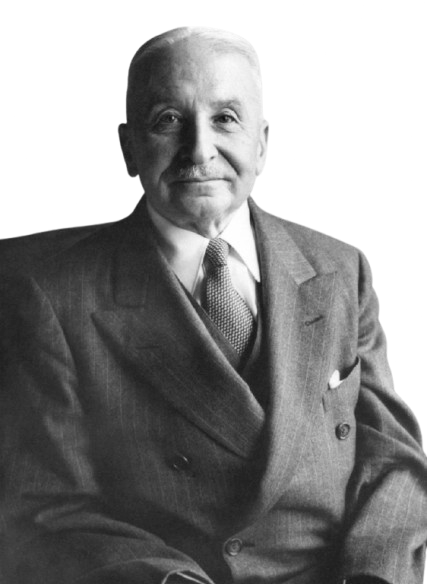
The economy can be defined in many ways; personally, however, I see it as resting upon three foundations: “Property”, “Freedom” and, no less importantly, “Availability” These are the foundations of a vigorous economy: there must be a good, there must be the freedom to trade it, and there must be the availability to do so.
I will not, in this meditatio, produce any kind of list explaining what each lesson contains — the book already does that very well. Instead, I will offer my own view while tracing the development of part of the work, perhaps being even more economical with words than Mises himself, but no less explanatory.
The Market as an Expression of the Popular Will
What cannot be denied about Mises and his visit to Argentina (Buenos Aires 1959) is that, had the Argentines listened to him, their economy would possibly not have ended up in ruins, and Kirchner would have been as far from the nation’s central chair as any other ordinary person. The truth is that the sweet words of those who understand nothing of economics, not even mathematical economics, deceive those who have no notion whatsoever of public operations; thus, it seems economically easy and viable to solve every social problem with a pen — of course, just draft a decree to make things cheaper, why not?
It is necessary, above all, to know what the market actually does — here I refer to the market in general. The capitalist market arises, ideally, to meet the needs of the masses. In short: if there is sufficient demand for whiskey, no restriction imposed on the market will matter, not even Prohibition — it is a war lost before it even begins. Because, if there is demand, there will be a market; it may be small or very large, but it will exist. As Mises explains in his first lesson on capitalism, the market is the maximum expression of the popular will, because, in order to express itself — to buy or sell — it requires the transfer of a resource presumed to be limited (gold, silver, time, or another).
“The development of capitalism consists in the fact that every man has the right to serve his customer better and/or more cheaply. And, in a relatively short time, this method, this principle, transformed the face of the world, making possible an unprecedented growth of the world’s population.” — Ludwig von Mises [] In other words, the man who sells his precious time — whether to make a whiskey, today permitted and appreciated in the highest courts of the world, but once completely forbidden in various countries by Prohibition, which was defeated by civil disobedience [] — can, by selling his time, sustain and fund a more comfortable life for his family, increasing family and generational wealth. A higher standard of living allows for consistent family growth; if he is forbidden from selling his time, which may be his only asset of real value in the market, then he is forbidden a comfortable life, a more prosperous family, and greater family wealth — in other words, he is forbidden his very own economic growth. Of course there will be the rhetoric that the man is being exploited, and that he would be better off if he did not sell his time — but better in what sense? Is it possible that someone would pay the man for valuable resources if they considered what he offers to have no value at all?
No! Because we naturally always choose the less costly option — saving our assets is a survival mechanism. If we save the resources spent on acquiring salt, there is more left over to also acquire sugar; thus, one pays the price one considers fair, but always with the clear desire to pay less for the same asset.
Furthermore, would the man be in a more satisfactory living condition if he did not sell his time, since this is his only asset? Mises answers this clearly:
“The old story, repeated hundreds of times, that the factories employed women and children who, before working in these factories, lived in satisfactory conditions, is one of history’s greatest hoaxes.” — Ludwig von Mises [] Although it is not necessary to question history to have the answer, it suffices to know that, if quality of life is superior without needing to sell this precious asset, there will be no need to sell it. If you do so, you do it because, had you not done so, your quality of life would have been drastically reduced.
Wealth, Shoes, and the Myth of Exploitation
Nowadays, the difference between a rich man (of many valuable assets) and a poor man (of few) can be defined in two ways: the first concerns the brand and quality of a product; the second, its quantity. A rich man in Italy has shoes; a poor man does too. A rich man owns more than one shirt; so does a poor man. Both use soap, have access to warm water and more than one kind of food, served more than once a day — something that, a few centuries ago, would have looked quite different. Back then, many men owned only a single pair of shoes, or sometimes not even that, just a sandal; they had no access to warm water in winter unless they lit a fire or used a wooden tub. In fact, it was precisely the need for hot water in winter that led São Paulo native Francisco Canhos to develop the electric shower.
In the words of Mises:
“Nowadays in capitalist countries there is comparatively little difference in the fundamentals of life led by the upper classes and the lower classes. Both have enough food, both have clothes, both have shelter. But in the eighteenth century, and in the centuries before, the difference between the life of a member of the middle classes and the life of one of the lower classes was that the first had shoes and the second had no shoes.” — Ludwig von Mises [] As I argued at the start of this section of Meditatio, it is relatively simple to elect whoever promises a free shower — but it is economically and socially unviable to force workers in the energy industry, the plastics industry, or even the shower-manufacturing industry to work for free, simply because a law says they must. It is like passing a law determining that a certain type of person, in a certain job, must offer his most important asset entirely free of charge. The great problem is not merely that some people want “free” bread, but that no one will work for free — not the baker, nor the one who wants the free bread —, because if the latter truly valued the bread, he would pay for it.
But besides the bread itself, there is much more hidden behind it: the farmworker who planted the wheat for the bread — who will pay him for the wheat sold to the flour company? Who will pay for the transport of the wheat, for the storage system, and what will the company receive? If the baker cannot sell the bread, then he cannot pay for the raw material that is the flour, and certainly the farmworker will not receive a single cent. In other words, by not buying the bread and wanting it for free, the person empties not only the baker’s table, but also the trucker’s, the farmworker’s, the flour company owner’s, and everyone else who depends on it.
But if this happens by not buying the bread, the reverse also happens in the mere act of eating bread in the morning: by paying for it, you transfer wealth layer by layer — from the baker to the farmworker —, who with that resource can, finally, have a more dignified and comfortable life. Even if it is only a single cent, in large volumes this is exactly what builds the wealth of the well-off.
This system of buying and selling, which enriches the smaller players in layers — tending to enrich some more and others less along the way — is the system of voluntary exchange. We say this because the sale of the wheat is voluntary: it is true that if one worker does not sell, another will, but he is in no way coerced into doing so. It is this system that we call a free economy — everyone is free to exchange goods, time, or whatever assets they consider valuable.
“What is the free economy? What does this system of economic freedom mean? The answer is simple: it is the market economy, it is the system under which the cooperation of individuals in the social division of labor takes place through the market. And this market is not a place: it is a process, it is the way in which, by selling and buying, by producing and consuming, people are contributing to the overall functioning of society.” — Ludwig von Mises []
Economic Freedom and the Error of Central Arrogance
Consequently, there is at least one mistake we make when we say “free market”: chief among them lies in the relationship between freedom and arrogance, in which the government tends to believe it knows what is best for the population and curtails the free market based on its own ideals.
As an example, imagine that, in order to end his population’s hunger, some supposed leader decides to order every citizen to plant rice and grow carrots. In a short time we would have plenty of rice and plenty of carrots, but we would have no technology, no trucks to transport them, no means of intelligent cultivation — and, at the first sign of blight, every crop would be ruined. Because some men are born to plant, others to transport, others to develop tools for the market, and still others to develop chemicals and fungicides; to deny them the freedom to choose their own career, or to follow the natural flow of the market, is to condemn everyone. This is something documented by Hayek in The Fatal Conceit [] and The Use of Knowledge in Society [], where he explains and goes even further — although I myself have already postulated that information from the edge tends to arrive at the center in fragments [], and thus is no longer the total information.
“But economic freedom, in effect, means that the people who own the means of production have the power to choose the way in which they want to integrate themselves into the whole of society. A person has the right to choose his career; he has the freedom to do whatever he wants.” — Ludwig von Mises [] The bad leader and the misinformed people share the same paradigm: that of fixing society, the economy, and everything else by their own means. For this reason, they accept certain follies, such as the erosion of freedom, and say that, for the majority to be free, some inevitably need to stop being so. For example, the central idea that, in order to put more rice on the tables of the poor, it suffices to block rice exports has no logical basis whatsoever. Although it seems to suggest that the rice will be directed to the domestic market, this is not true: if the producer cannot sell at a price he considers acceptable, he will stop planting rice; with stocks low, merchants will have to raise prices, and the little rice that remains will be sold at high prices in parallel markets. In short, the measure meant to increase the amount of rice on the poorer classes’ tables achieves the opposite effect — an effect that cannot easily be reversed by law. Freedoms are chained together and inseparable; thus, if a country has no free market, it has no other freedom either — and if there is no freedom of production there, neither is there freedom of expression, which is merely the verbalization that precedes the act. Of course we can, in short, imagine counterexamples of states that allow more of one form of freedom and less of another, but the abolition of one form of freedom also means, ultimately, the abolition of the rest.
The Chain of Voluntary Exchange
This system of voluntary exchange among individuals is what allows the wheat farmer to have enough to buy or acquire his own land, and thus to expand and make his savings ever more substantial. And this happens precisely because he offers good wheat at a competitive price to many customers — the customers become his bosses and also the benchmark for quality and price. It is said that wheat will be worth whatever someone is willing to pay for it.
The capitalist system is the only one that allows a wheat farmer to grow and expand to the point of possessing wealth greater than that of the kings of past centuries. In a socialist system, where means and ends are subdivided, he would not have the same capacity, since he would not be allowed to have more than another farmworker, nor to eat more than him. Such a closed system prevents economic growth and the development of the market for the poorest individuals, favoring — as history documents — only the regime’s leaders, to the detriment of the poorest people themselves.
“The socialist system, however, forbids this fundamental freedom, which is the choice of one’s own career. Under socialist conditions there is a single economic authority, and it holds the power to decide all questions relating to production.” — Ludwig von Mises [] In this way, the entire system depends, inevitably, on the wisdom, knowledge, and sense of justice of the “supreme” leader. And, in a quick analysis of power and risk, we can deduce, based on the weight of history, that all central planning, by deteriorating personal and private planning, has dictatorship as its ultimate destination. So-called dictatorships are not self-sustaining on their own; they depend on the support of other nations, on expropriation, or on large-scale production under rigid control, nearly — if not identical — to military control. However, unlike military forces, which are indefinitely subsidized by taxes and fees, the socialist system has no self-subsistence, because, since there is no free market, there is no investment nor correct pricing of raw materials. There is no way to know the real value of rice when it cannot be freely sold, nor the correct value of the raw material for producing rice or dairy. How can you price cheese without first pricing the milk, and without correctly pricing or selling the cow’s feed? Thus all prices are sustained by an illusion of an egalitarian market, in which there is no milk of higher or lower quality, nor of higher or lower price — all at the same price and the same quality, sustained by an abstract unreality.
“When this fact was discovered, the socialists did not know how to react properly. For 150 years they had asserted: ‘All the evils of the world come from the existence of markets and of market prices. We want to abolish the market and, with it, of course, the market economy, replacing it with a system without prices and without markets.’” — Ludwig von Mises []
Socialism, Nationalization, and the Illusion of Prices
The great problem with illusions goes beyond the fact that they are not real; it lies in the fact that they have an expiration date far shorter than one previously imagines. That is, many people cling to the ideal that an illusion will last forever, but, for whoever observes from the edge of the system, its premature disintegration is evident. One cannot sustain an entire economic and price system on an illusion. One cannot, from a high-rise building downtown, tell the rice farmer how much he must sell his rice for, or whether he should plant rice or wheat. The market system is the only one capable of diversifying and dividing power, responsibilities, and, obviously, profit in a fairer way — unless your ideal of justice is unattainable.
During the rupture between illusion and reality — or, at times, even before the rupture begins —, an enclave arises between those who defend truth as the absolute source of knowledge and those who protect the system, either because they do not know how to live without it, or simply because they do not want to. Whatever the reason, this leads to heavy state intervention.
Interventionism, beyond the very evil it represents, raises public spending to a high level, since it becomes necessary to police what people say, sell, and do, as well as to build more prisons and invest more in illusory propaganda. In short, two alternatives remain, neither of them healthy: either more taxes are collected to feed the interventionist system, or more paper money is printed. Both, when taken to the extreme, end up deteriorating the entire system. But I am not referring here — nor does Mises refer, in the book — only to intervention in freedom of expression, but also to intervention in economic freedom.
For example, if the State prevents the milk producer from selling his milk — given that this is a vital food —, it will itself have to find ways to supply this product. It can do so, and sometimes does, through state-owned companies, which are often financed with the taxpayers’ own money.
Unlike a private company, whose profit and capital are priorities — which obliges it to provide a product of equal or superior quality to that of its competitors, or at least at a lower price —, state-owned companies have the privilege of not worrying about competition, since they are generally the only ones in the sector. And, even if they were not, they would have at their disposal the government’s disproportionately large investments. The metrics defined do not matter; what matters is the result, which tends to be a deficit. But unlike what happens with private companies, a deficit for a state-owned company simply means more investment.
“If the deficit is not soon removed, and if the enterprise is not going to become a paying business or at least show signs that it will not continue to suffer deficits or additional losses, the individual goes bankrupt and business stops. The government is in a different situation. It can go on with a deficit because it has the power to tax the people.” — Ludwig von Mises []
Price Controls and Their Consequences
Another great problem in the relationship between state-owned enterprises and the free market lies in the price factor. A private, free company is, supposedly, free to price its product however it sees fit — it can, for example, charge more for the use of its brand than what the product actually costs in raw materials. This mechanism allows for organic competition, since an overly expensive product opens space for a similar product of lesser value.
However, this mechanism does not work for state-owned enterprises, since these depend exclusively on a committee, department, or ministry to approve any price increase or reduction. And, since for these committees there is no real personal loss in maintaining deficit-ridden values or an abusive price, they routinely make the mistake of assuming they can define the market by their own metrics. Often they cannot see the whole picture — such as the costs of raw materials, transport, and other factors —, only the final cost; nor do they need to concern themselves with creditors or fees.
When, in the end, they cannot or will not nationalize a large number of companies, they resort to price controls — which is nothing more than a decree determining how much each merchant may sell his product for. For example, it can be decreed that the milk producer may not sell his milk above the value the ministry considers fair. This, in turn, ignores the fact that one producer may use higher-quality raw material than another and, thus, produce a better milk at a slightly higher price — putting all producers, large, small, or niche, under the same criterion.
The result, at first glance, is a reduction in prices and heavy surveillance in markets and sales centers; then, the total shortage of the price-controlled product. This happens because, although the price is fixed, the raw material for that product will continue to follow the market’s natural flow — and so will the producers, once they realize that producing milk brings them more loss than simply selling the cows’ meat. Many producers tend to give up the venture, and thus the milk — still price-controlled — will tend toward a “tied-down” overvaluation. Mises cites two good examples in the book, though one need not go so far to understand how vain the idea of price controls really is.
“And the Roman emperors were not known for moderation in enforcing their laws: death did not seem to them too severe a punishment for anyone who dared to charge higher prices than those stipulated.” — Ludwig von Mises [] Before thinking about freezing prices, we must pay attention to why this happens: do we consider the prices charged for milk or cheese unjust? Is it up to the government to impose a maximum price, to the detriment of the organic market? Or is the price high not because of the product itself, but because of the inflation caused by that very same State? The State’s solution to a problem directly caused by the State’s own actions could not result in fewer problems — only when the State itself is compelled to restrain itself, or even to retreat.
“The idea of government interference as a ‘solution’ of economic problems gives rise, in all countries, to conditions which are, to say the least, highly unsatisfactory and often chaotic.” — Ludwig von Mises [] Of course, as stated at the beginning of this meditatio, people want milk, rent, wheat, bread, and everything else at the lowest possible price — although these same people want to obtain the greatest possible profit when it is their turn to sell something. Likewise, they would not find it fair for the State to dictate what to sell and at what price. They may even believe that, when the State dictates, it dictates only according to the interests that benefit them, but they forget that the State has its own interests and that, at times — most of the time —, those interests contradict its own promises.
Inflation: The True Face of Interventionism
The State, naturally, cannot exist without abundant consumption of resources. As an example, imagine a State that cannot even defend itself and its own established system. The great question is not the consumption of resources, which is, in other words, inevitable, but rather how hungry for those resources the State is, and how much it is capable of devouring.
In the era of the gold standard, this consumption was limited to the amount of gold existing in the State, since, evidently, the State could not consume beyond the wealth existing on-site. But the modern State, with paper money, managed the feat of artificially creating two ways to grow beyond local wealth: debt and money printing. I will not go deeper into these, since that falls outside the meditation of the late Mises’s own book — I reserve them for another occasion.
However, Mises deals precisely with the consequence of both: inflation. And inflation cannot be defined in any way other than an increase in the quantity of money in circulation. Contrary to what might be suggested, inflation is not the rise in prices. In reality, products remain at the same cost — sometimes even lower, thanks to technological advances that favor faster manufacturing or acquisition of raw materials. What happens, in short, is the devaluation of the currency.
When a State prints more paper money, it incurs two consequences. The first is that whoever is served with this new batch starts off at a great advantage, since they face a market that has not yet felt the effects of the new printing. The second consequence arises from the market’s reaction to the increase in demand: with part of the population having more resources from the new batch, but with stocks low, the market is left with no choice but to raise prices due to the heightened demand — supply simply cannot keep up with the speed at which the government can issue currency.
A closer example: during a war, the State may invest in uniforms and helmets, and, to do so, it becomes necessary to print vast sums of money. The first to receive it are the textile and metallurgical industries, which now convert their factories — once devoted to clothing and refrigerators — to accommodate the military industry. This creates a clash of supply and demand: on one side, ordinary people wanting to buy clothes and refrigerators; on the other, the military industry consuming on a large scale with newly printed money; and, on yet another side, the workers of those industries spending their inflated wages also on new refrigerators and clothes — creating a disparity between groups. This is a documented effect, known as the Cantillon effect, an economic theory formulated in the eighteenth century by economist Richard Cantillon [].
“In the end, inflation ends in the breakdown of the whole monetary system, in a catastrophe similar to that which occurred in Germany in 1923. On August 1, 1914, the dollar was equal to 4 marks and 20 pfennig. Nine years later, in November 1923, the dollar was equal to 4.2 trillion marks.” — Ludwig von Mises [] Ultimately, the abuse of money — or the mere abuse of the power granted to whoever produces it — results in something not too different from the destruction of the currency itself and, at times, of the very State that issued it. One of the signs that the dying system is finally drawing its last breaths comes from the fact that the people living within it begin to realize that it is not beneficial to save money or to be a creditor, but rather, on the contrary, to become a debtor and buy any and every real asset, merely to hold onto it. This is a clear sign that, for these people, value no longer lies in money, but in the things that can be traded for it. Thus, inflation feeds on itself: to pay for the price increase, higher wages are needed; for that to happen, more currency in circulation is needed; and for that, the printing of more paper money is needed — which, in turn, will feed the cycle once again. As we have been able to observe, the State holds no absolute value. Although it may obtain money in an almost infinite manner, nothing guarantees that this money is worth more than the paper on which it was printed. And, at times, it is worth far less, thus being merely an added cost to manufacture it. But the governments in power do not usually think this way.
Foreign Investment, Expropriation, and Poverty
When an underdeveloped country aims for full development — and here I give a sense to “full development”: a nation whose people have jobs, with satisfactory income, and “full employment,” in Mises’s own sense —, it must not seek to inflate its own currency, nor decree that companies pay more. This, as stated, does not work and produces the opposite effect.
“An entrepreneur cannot pay to a worker more than the amount added by this worker’s employment to the value of the total output of the process of production concerned. He cannot pay him more than the customers are prepared to pay him back for this particular contribution to the total work accomplished.” — Ludwig von Mises [] Of course, in turn, companies, ordinarily, when they grow, can finally pay better salaries, which provides a more favorable living condition for their employees. But, as stated, in an open market, every company aims for profit. In fact, it is born precisely for that purpose. And there is nothing wrong with profiting — it is not a “sin,” nor a criminal act. The only ones offended by someone else’s profit are those who want to seize it for themselves. If you ask a bakery customer whether he knows that, by buying bread at that bakery, he made the owner richer, it is unlikely you would get a negative answer. On the contrary, the customer knows and simply does not care — what actually makes a difference to him is the quality of the bread and the price at which it is sold. A good example of this is that most people do not ask themselves where the milk or the wheat comes from, nor whether the wheat is produced domestically or not — they tend to buy based exclusively on cost-benefit alone. Thus, it matters little to the customer whether the rubber was produced in Malaysia or the Philippines, so long as it is of good quality and at a lower price.
In part, this is what we call foreign investment: allowing another country to sell a product at a competitive price, or even of superior quality, at a higher price. In other words, foreign investment can be described as other people’s capital entering a nation other than their own, which can benefit both sides. This is because it allows buyers of, for example, milk to have an additional option in price and quality; it allows transporters or sellers to have an additional trading option; and it allows the dairy company and the farmers to gain new customers.
But this investment is only viable when there is, for example, trust and space. If there is no space — as, for instance, in situations where a state-owned company is also a monopoly —, then there will be no foreign investment due to lack of space, not lack of need. The second factor is trust: a company will only invest in a country it trusts not to have its assets stolen, expropriated, or in any way nationalized.
Something like what happened in Cuba, when the communists, having seized State power, nationalized dozens of companies from different countries — which caused some of those countries, chief among them the United States of America, to impose heavy sanctions. What followed in Cuba was the absence of space and trust for future investment, which made good-quality imported milk, chocolate, meat, and other goods disappear from workers’ tables — but not only them: also manufacturing for quality production and agricultural technology, throwing the country back a hundred years.
The home of an average American will have better conditions and a better housing situation than the home of a wealthy Cuban, and it is not illegitimate to say that the Cuban middle class is far from the poorest American class in comfort and quality of life. But this is not due to the American being superior on any physical level, but rather to the fact that the American has more access to resources, because his country has more freedom for companies to provide good-quality products at low prices.
Conclusion
During the reading and meditation of this book, I journeyed through the Roman Empire, Britain, pre- and post-war Germany, and, finally, the “rigid,” modern economic states — though Mises did not use this term — and we were able to establish that economics is a natural human expression. Thus, man naturally buys and sells, just as he negotiates his time.
Whoever thinks that such a dynamic system can be partially rigidified without, at some point, ending up completely strangled is mistaken — and once the market is strangled, so is the stomach of those who depend on it. Mises describes well what the State does, and how it does it, to impoverish itself, to flagellate itself, and, ultimately, to destroy the generational wealth of the civilian population. Thus, we say that what the State should do is exactly the opposite of what it currently does.